
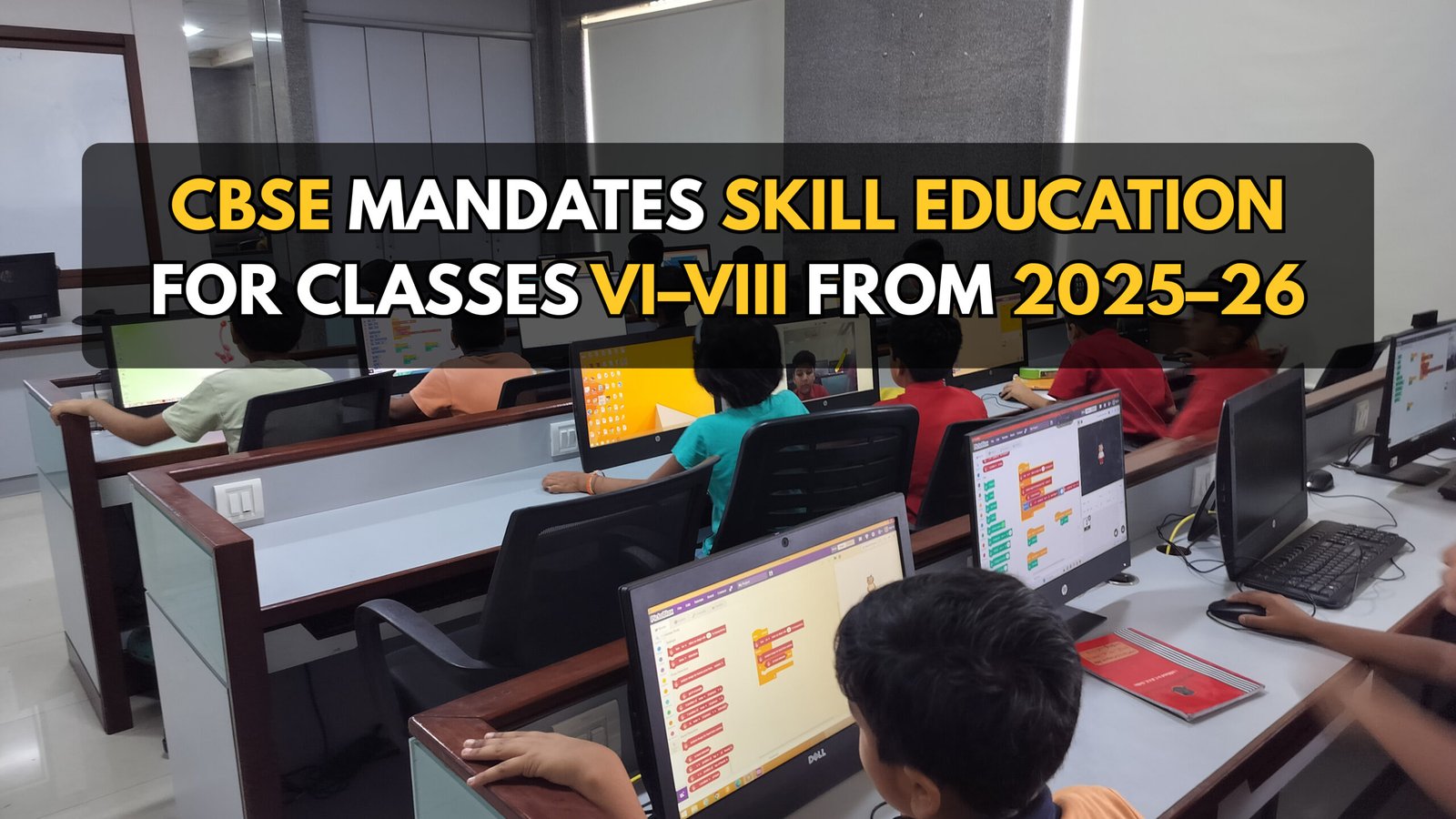
1. Introduction to the CBSE Skill Education Reform
The Central Board of Secondary Education has taken a decisive step through Circular No. Skill-81/2025 dated 28 October 2025, making Skill Education mandatory for Classes VI to VIII from the academic year 2025–26. This reform directs all CBSE schools to immediately adopt NCERT’s Kaushal Bodh textbooks, shifting middle-school learning toward competency-based, experiential, and practical education aligned with NEP 2020 and NCF-SE 2023.
The Board has emphasized that despite earlier circulars, many schools have not begun implementing these resources. This new mandate ensures that Skill Education is not optional but integral to schooling, requiring structural changes in the timetable, teaching approach, and assessment practices.
2. Mandatory 110 Hours of Skill Education
A key requirement is the allocation of 110 hours of Skill Education each year, achieved through two consecutive Skill Education periods twice a week. Schools must redesign their timetables genuinely rather than adjusting them superficially. This ensures that learners receive uninterrupted, hands-on engagement in Skill Education every week.
Sample Timetable (Insert Exactly As Below)
| Day | Period 1 | Period 2 | Period 3 | Period 4 | Period 5 | Period 6 | Period 7 |
| Monday | English | Math | Science | Social Science | Skill Education | Skill Education | Games |
| Tuesday | Math | English | Science | Computer | Hindi | Sanskrit/Art | Life Skills |
| Wednesday | Social Science | Science | English | Math | Skill Education | Skill Education | Library |
| Thursday | English | Hindi | Math | Social Science | Art | PE | Value Ed. |
| Friday | Math | Science | English | ICT | Hindi | SUPW | Readiness |
| Saturday | Art/PE | Clubs | Remedials | — | — | — | — |
This model fulfills the CBSE-mandated 110-hour requirement with clarity and consistency.
3. Three Mandatory Projects per Class (Project-Based Learning)
Skill Education under Kaushal Bodh follows a project-based learning framework. Each student must complete three structured projects every year—one each from the domains:
• working with life forms
• working with materials and machines
• providing human services
The emphasis is not on perfect outcomes but on learning through doing, problem-solving, collaboration, and practical creativity.
Project Calendar (Insert Below)
| Month | Focus | Project Work |
| June–Aug | Foundation Skills | Project 1 |
| Sept–Nov | Applied Skills | Project 2 |
| Dec–Feb | Real-World Problem Solving | Project 3 |
| March | Kaushal Mela Prep | Showcase |
By Class VIII, every learner will have completed nine hands-on projects, creating a strong base for future vocational or technical pathways.
4. Competency-Based Assessment Framework
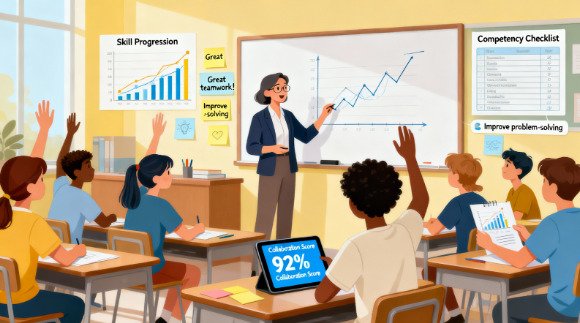
With this reform, CBSE moves schools away from theory-heavy assessments. Evaluation will consider:
• portfolios
• activity books
• teacher observations
• written components
• student presentations and viva
This ensures a holistic, competency-based assessment, capturing students’ real skills, creativity, and hands-on capabilities—aligned with the core objectives of Skill Education.
5. Year-End Kaushal Mela (Skill Fair)
Every school must host a Kaushal Mela at the end of the academic year. This fair becomes the platform for students to:
• display their projects
• demonstrate skills learned
• engage parents and the school community
The Kaushal Mela also acts as evidence of compliance during inspections or audits.

6. Teacher Training and Implementation Support
CBSE will conduct teacher training programs with NCERT and PSSCIVE to ensure effective adoption of the Kaushal Bodh series. Schools must identify teachers who can lead projects, manage activity books, and handle hands-on modules confidently.
This reform requires schools to rethink teaching roles, classroom planning, and lesson delivery, shifting from textbook-driven learning to activity- and project-based instruction.
7. Why This Policy Matters for Indian Schools
This is one of the most significant transitions in Indian middle-school education in recent years. It pushes schools to:
• focus on skills instead of rote knowledge
• introduce students to real-world problem-solving
• integrate creativity, teamwork, and innovation into learning
• align school education with industry-relevant competencies
Schools that implement early will not only meet CBSE’s compliance norms but also ensure their students are better prepared for a future driven by technology, automation, AI, and hands-on innovation.
GoGlobalWays: A Catalyst in Enabling this Transformation
As schools navigate this major transition, GoGlobalWays acts as a catalyst and strategic knowledge partner, supporting institutions in implementing CBSE’s Skill Education mandate smoothly and effectively.
GoGlobalWays has been at the forefront of establishing AI Labs, Coding Labs, Robotics Labs, and Composite Skill Labs in schools—learning environments that naturally complement the Kaushal Bodh Skill Education framework. Our expertise in experiential learning, skill development, and hands-on pedagogy aligns directly with the requirements outlined by CBSE.
We assist schools in:
• designing the 110-hour Skill Education plan.
• mapping Kaushal Bodh chapters to weekly schedules.
• planning, documenting, and assessing the three mandatory projects.
• training teachers to deliver project-based learning confidently.
• setting up physical resource spaces like Skill Labs.
• structuring and conducting the fairs like Kaushal Mela.
• building student portfolios and assessment evidence.
With GoGlobalWays as their knowledge partner, schools can ensure full compliance with the reform while upgrading their learning environment to meet 21st-century skill demands.
Conclusion
CBSE’s mandate is more than a policy requirement—it is a national-level shift toward practical, skill-oriented, future-ready education. Schools that adopt it sincerely will give their learners a significant advantage. GoGlobalWays stands ready to support institutions in becoming NEP-aligned, technology-enabled, and skill-driven campuses capable of empowering every student for the future.